I am behind on the writing prompts. While I’m writing this, I should have 2 posts on backup and I don’t. I could blame it on a lot of things but one of my roadblocks is I want to make a writing prompt post and y’know what? I am having trouble with this sci-fi/fantasy crossover posts. Why? Don’t know, it’s just lodging a blockage in my brain flow and I’ve had a post started for it for 2 weeks and haven’t been able to sit down and work on it. But I want a post on time on Monday so I’m going to post something.
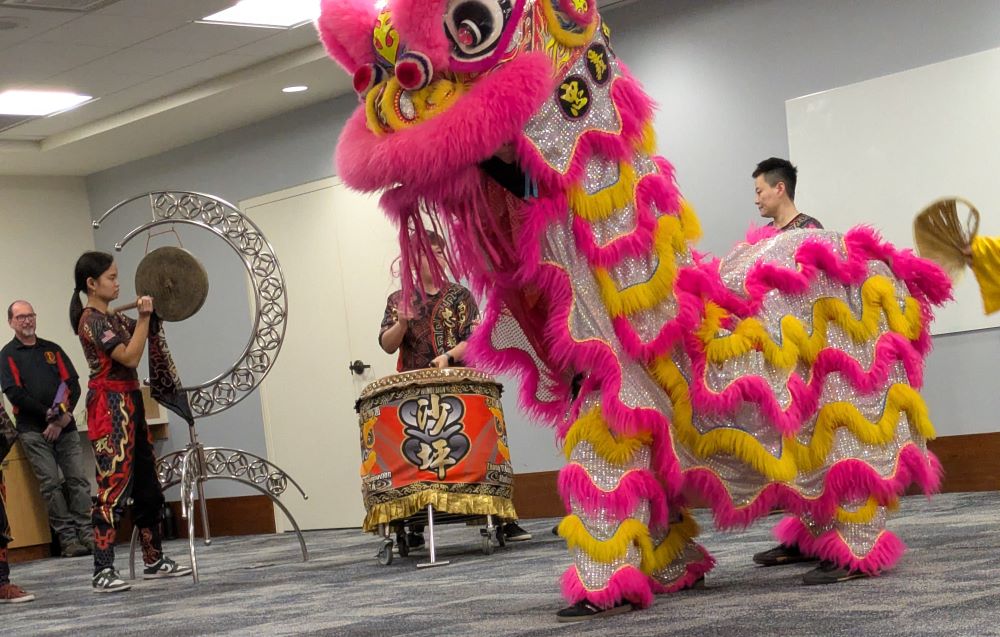
Today (last Saturday) was the day we went to our library’s yearly Lunar New Year celebration where they invite a troupe of lion dancers from Madison. The Zhong-Yi Kung Fu Association have performed and competed around the world, even placing 2nd in a competition in China a few years back. They source their costumes and equipment from China and were trained by a Chinese master. We enjoy their performances and I enjoy learning more about the culture behind it. And I want to share some of that here. My source is the leader of the troupe; if you have better sources, please tell me about them! But also note that they are in a specific style based on one village whose name I did not manage to record; differences may arise from that.
First off, the story! Because I like the story always. The performance is by several lion dancers, a more experienced member of the team as the Big-Head Buddha (see pictures), and a team playing the music. I’m explaining that part because it’s important to know the characters in the story. Speaking of the music, if you’re going to a dance, take ear protection; the instruments are giant drums that you will feel in your bones and your throat, a big gong, and some cymbals. The rhythms they play (18 in this style) help the lions know what moves and which part of the dance they are on. Back to the lions! The story goes that the Buddha found and raised the lion cub in his temple. One day the lion got out, went down to the village, and inadvertently began terrorizing the villagers, causing havoc. The Buddha went down after him and guided it back to the temple, using his fan which the lion feared.
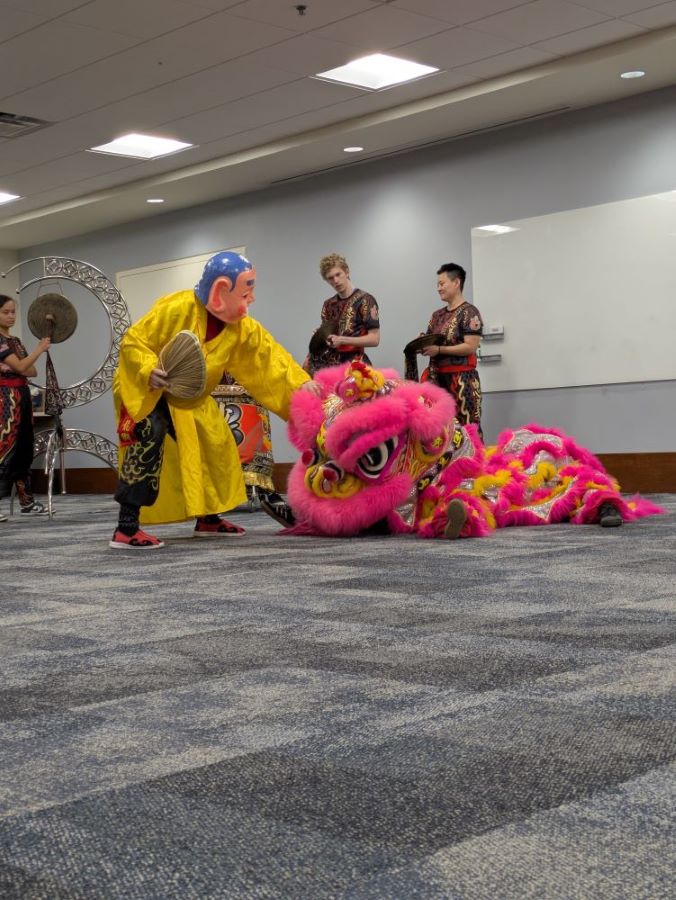
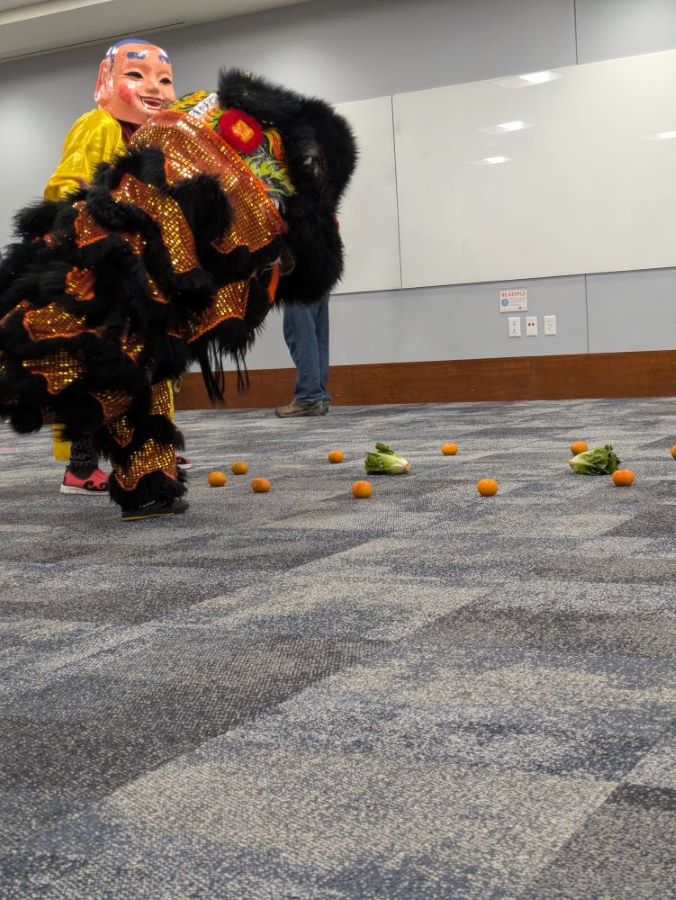
The smaller story, within the dance, has the Buddha going to each lion and waking it up, letting it wake slowly with its eyes blinking and its head going around, then it begins investigating the world around it. The lions get up and wander through the audience, saying hello (and collecting donations in red envelopes) and letting the kids pet their fluffy faces. It’s fun to watch the younger kids who really don’t know how to react. The 3-5 age range either gets super into it or pretty terrified. After that, the lions discover treasure and begin distributing it. There’s a ring of mandarins/tangerines and within it are some heads of lettuce. The lions must break the circle, taking the tangerines and tossing them from their mouths out into the crowd. Catching one is supposed to bring wealth in the coming year. When that’s done, the lion can access the heads of lettuce which it “eats,” shreds, and then spreads out to the crowd. Again, catching and keeping the lettuce will bring fortune in the coming year. (I got some stuck in my hair so we’re set for the Year of the Horse!) They finish up by displaying a banner; I did not clarify how that fits into the story. But the idea with the tangerines and the lettuce is that they are near homophones in Mandarin with “gold” and “fortune;” therefore, the spreading is symbolic of the lion giving back to the community as a whole.
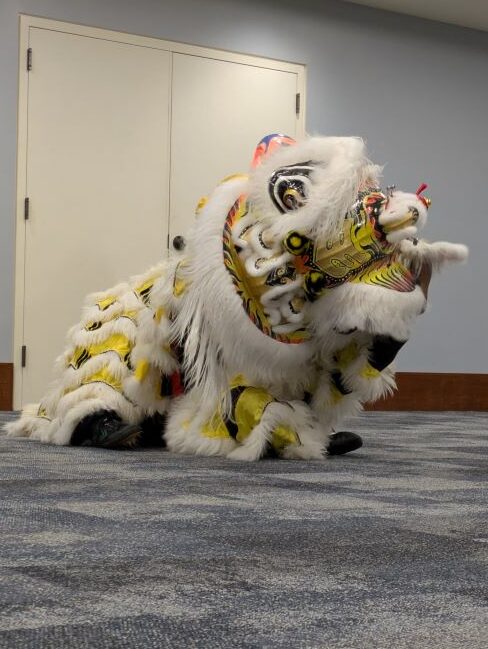
The reason the lion can do this is because the lion is an agent of change and transformation. Each lion is also “alive,” they went through a ceremony when they were made in China that gave them an identity. They often have names on the back; one of the lions that was dancing today had a symbol that meant Loyalty. The colors are symbolic as well. Red and yellow are auspicious colors and lions with those colors are used at weddings. Lions with black fur are young lions while ones with white fur are for older, more experienced dancers. There are also lions with specific color patterns which I did not write down that represent specific people from Chinese history, like the three generals who are said to have unified China.
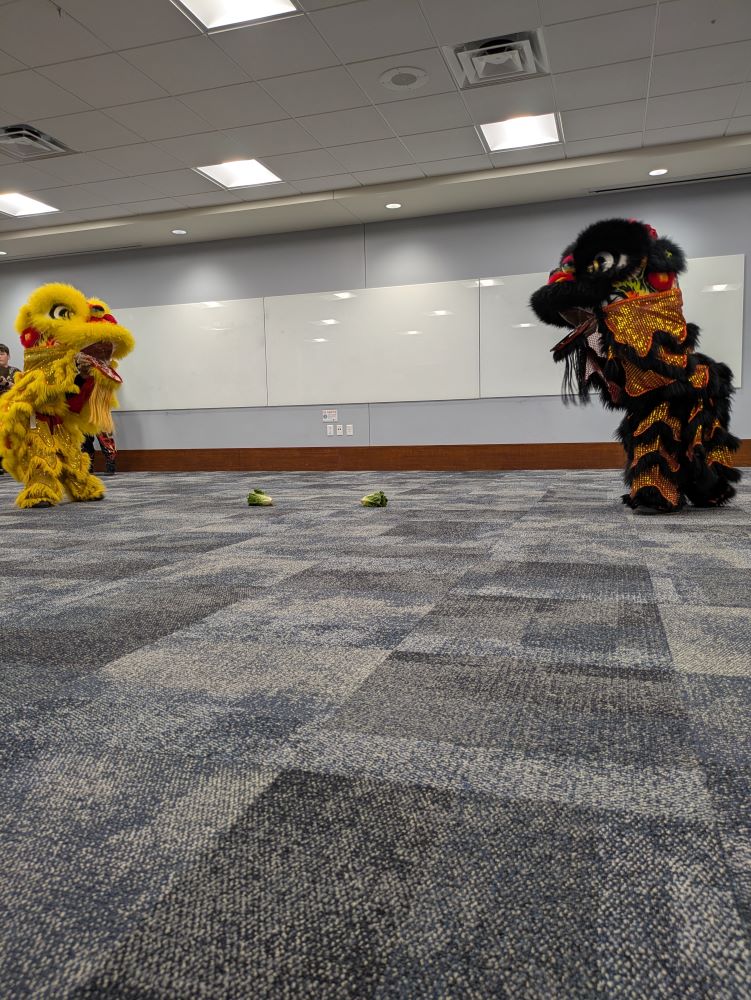
Also, important note: Lions are for 2 people max (the younger dancers at the performance were solo because apparently the size of the lions made it difficult to have multiple dancers) and dragons are the ones with more than two people; for example, the ones that dance on the ends of long poles going in loops and swirls. The dragons are more of a dance while the lion performers are martial artists so their moves are much more demanding. There are kicks and twists and balancing and lifts that they can do, plus one of them is crouched down to be the back the entire dance which must be rough. (On that note! They told us we could pet the lions but not to pet them on the backs because, you know, that’s a person’s back. A little awkward.) But basically: 2 dancers = lion; 3+ = dragon. Both = awesome.
What do I like about the lion dances? Aside from the skill on display and the colorful costumes, I love how much the lion comes alive. I can believe that it’s a real creature, investigating the world with curiosity and wonder. And the mythos behind it of course! I’m a sucker for a good creature mythos in case you didn’t know.
Intellectual Property of Elizabeth Doman
Feel free to share via link
Do not copy to other websites or skim for AI training
Intellectual Property of Elizabeth Doman
Feel free to share via link
Do not copy to other websites or skim for AI training
Sounds like it was a fun experience! And a very cool story.