
Introducing characters has been on my mind of late while writing. I’m trying to work through another (I think I’m on my third time through this scene?) introduction of the crew of the Argo to Jason and Euphony/Orpheus. This likely isn’t the last draft either but this is an important one for me so I can peg character voice and actions. And introducing them quickly is also important. In the original Jason and the Argonauts, there are *does a quick count of my tally in my version* 54 crew members named in the introductory scene. FIFTY FOUR.
Obviously I’ve pared that down- a lot– and pared it a little more after my initial culling, but I’ve still got about two dozen crew members to introduce. Each introduction needs to accomplish the following things:
- Give their name
- Give and often introduce their species
- Explain why they wanted to come on this mission
- Show their specialties
- Often explain parts of how the ship works
- Show a bit of their personalities and interpersonal skills
At a minimum. Now, I’ve got Euphony being a narrator for me, so I could have her tell her audience “We boarded the ship and met Lynceus, who would be our second mate. His brother is Idas who’s the security guard. They’re both Long-Sights1 which means they have…” blah blah blah. But that’s boring to write and even more boring to read. And I know this because I read the crew introduction in the Argonautica, which was that. Now, at the time it was written/developed/performed/etc, this was kind of okay. The crew of the Argonautica was a veritable who’s who of Greek mythology, a true Avengers Assemble moment.
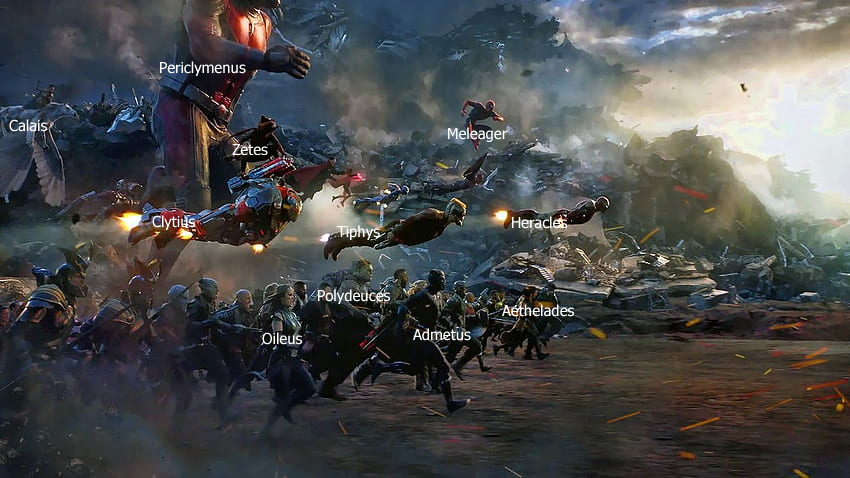
Fine for a Greek epic, especially when these people get their own movies poems to set up their characters already, and when probably thirty of them show up once or less during the rest of the story. Not fine for me. Dull and bad writing. So how do I do it without making it the whole book?
… well I’m at 6k words and counting on just introducing the ship and the crew so what am I doing writing this?…
Seriously though, you make it move. Give it action. Have them doing something, being in an interesting place, interacting with something. Other people talking about them also helps. Description is often easier for someone who’s not the speaking character as you get to describe them on approach, but even that should stay short. Don’t go “Jason stood about as tall as a 5 foot 7 tree and had olive-colored skin with green eyes and tousled brown hair. He wore a mauve button-down shirt with black trousers and a belt like the champion of Wrestlemania. His muscles though did not bear up that fact as his arms were twiggy and his shoulders definitely had the tone of someone who lets other people work for a living.”
okay maybe that’s not terrible but partly because I was being a little ridiculous and it’s late while I’m writing this. But it’s better to tie it to actions or comparisons. Mostly because you can accomplish multiple things at a time. Better is “Nikolas’s smile crinkled his gray-blue eyes as he helped Clio steer her chair through the Argo’s hallway door. Her hair managed to be shorter than his, as he’d let his brown hair grow long and wavy and Clio kept her black hair close-cropped enough to stand up on the top of her head.” We don’t get as much, no, but in roughly the same amount of space we’ve gotten character description and some physical description for two people. In general in a book, it’s less important to know what someone is wearing than to know what kind of behavior you can expect from them. Shortcuts are also good. Smile crinkling the eyes=sincerity. Someone in a wheelchair=probably has something rough going on. Helping someone in a wheelchair=thoughtful. Shortcuts=good in this situation.
I think it’s also important, for that reason, to encounter the character in a, let me say normative? state. That is, if we run into a character when they’re in an especially heightened emotion, it’s going to skew our perspective of that character. If a normally calm character has been pushed to their limits and is shouting at someone who’s taken it too far, we don’t know they’re normally calm and we’re spending all the rest of the time we know them confused. If you wake someone up for the introduction, there had better be a very good reason (ie early in the morning) or we’ll expect them to be lazy or sleepy. Sad, frustrated, confused… whatever it is, if that’s what we’re seeing when we meet them, that’s what we know them for and if it’s not part of their character, don’t do it.
There are exceptions, sure. For example, if I want to show that a character is level-headed under pressure, I can introduce them during a scene where it’s clear that there’s tremendous pressure on them. Like, they’re steering a spaceship through an asteroid field while being shot at and someone’s decided this is also the time to audit them. I can then let them vent some frustration at the auditor to make it clear that the situation is getting to them but I can also work in a pithy one-liner to show they’re clever, or I can make the response level to the point of ominous, or I could have them ignore that person but call in someone else to take the annoyance away before the ship crashes. If the situation clearly warrants an emotional response, we’re going to be more understanding and accepting of that character being different later, and also that moment can endear the character to us from the outset.
Showing something to like about a character in the moment is also important if you want that character to be likeable in general. It doesn’t all have to be for the same reasons. I make one character bubbly and effervescent. I make the next grumpy, sarcastic, and wry. Another is absent-minded but intelligent. Yet another seems very stoic but shows they’re willing to listen to someone’s well-reasoned opinion even if that person is young. Or they’re just pretty, like the person I made a hummingbird just for fun.
Beyond that, and adding on to that, memorable. If this character is going to be important, or if you just want them to stand out, give at least one thing that’s going to stick in someone’s mind. Especially in this giant roster, I want each of them to have something I can bring up again later, next time we meet them, to immediately pull them back to mind. Oh that’s right, this one’s the workaholic. Oh yeah, they’re the one who carries a massive gun and is protective. Oh this is the person who immediately didn’t trust our main character.
So to make a long post a little shorter, to introduce someone quickly-
- Meet them while they’re doing something
- Descriptions should work dual duty
- Use shortcuts to your advantage
- Make characters memorable and distinct
- Make sure their reactions are typical of them
It’s a lot. I’ve been working on this section for a long time and it tends to take a lot out of me because that’s a lot to balance. But it’s important for others to get to know the characters, and it’s important for me for the same reason, so that as I proceed with the story I can know who they are, what they want, and how they’ll behave in a given situation. Good luck with your own writing journeys.
Intellectual Property of Elizabeth Doman
Feel free to share via link
Do not copy to other websites or skim for AI training
- species name might change ↩︎